Systems · 2026-11-13
Rethinking inference without NVLink
On our RTX 6000D cluster, two GPUs in the same server talk more slowly than two servers do. Every design choice in our stack follows from that one measurement.
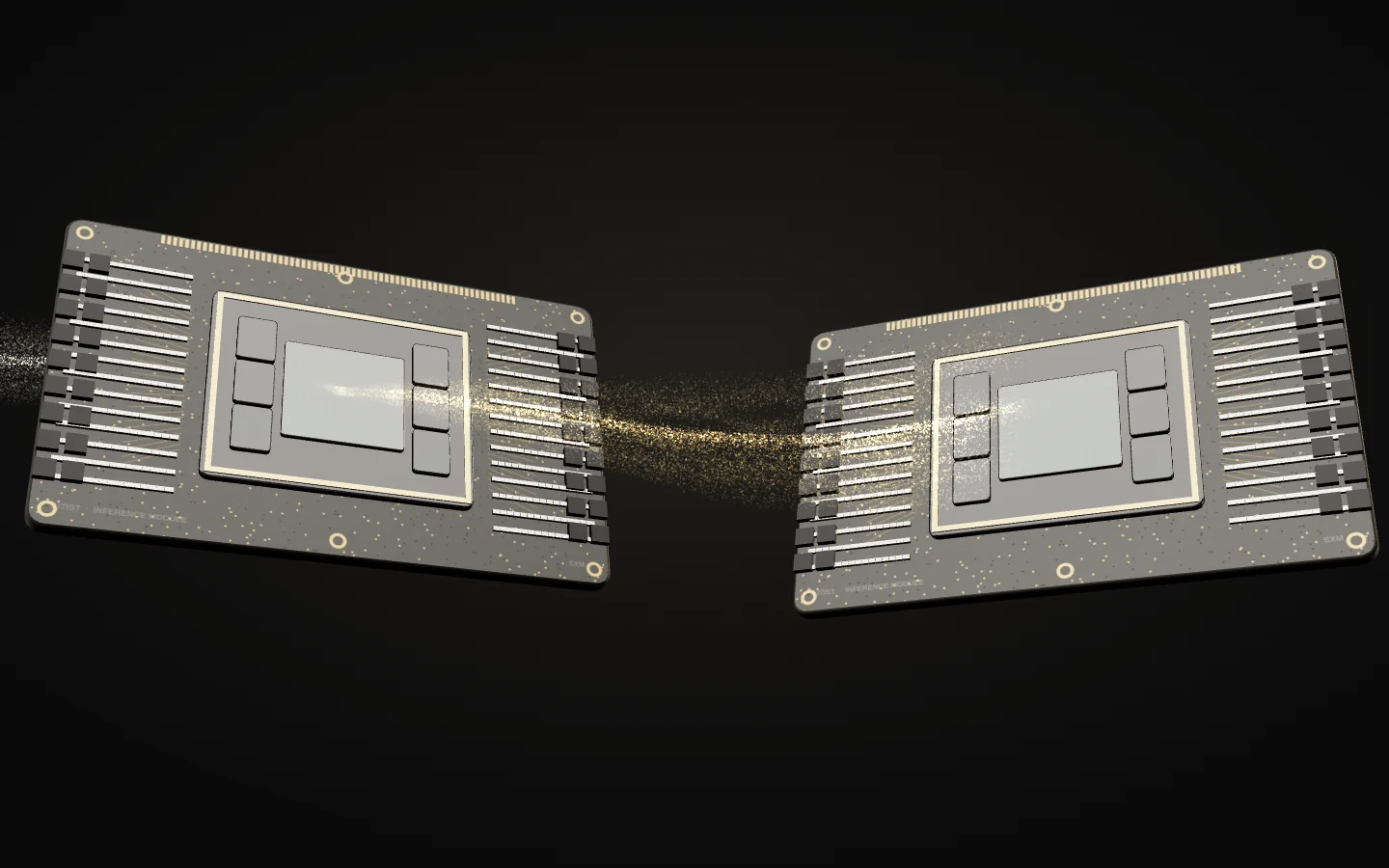
A machine that breaks the usual rules
We serve four frontier MoE models (GLM-5.3, DeepSeek-V4.1-Flash, GLM-5.3-Flash and Qwen3.8-Flash-Next), all with a 1,048,576-token context, on 39 nodes and 312 RTX 6000D GPUs (Blackwell SM120, 84 GiB each). There is no NVLink. Each server holds eight GPUs split across two CPU sockets, and every GPU has its own 400G ConnectX-8 NIC with GPUDirect RDMA. The workload is mostly coding agents: long inputs, tools, many turns, and prefix-cache hit rates of 96–99%.
We measured the whole bandwidth ladder before tuning anything. Memory bandwidth reached about 96% of spec and compute was ample (FP8 259–288 TFLOPS, NVFP4 526–571 TFLOPS). The bottleneck was the PCIe fabric inside each node.
Where the time went
We profiled one 128K-token cold request across all eight tensor-parallel ranks and aligned every collective by call index. Almost half of each prefill chunk was spent moving data, not computing.
That gave us four working rules: do less communication (prefer parallelism that needs fewer collectives: pipeline, context and MoE tensor parallelism); route by message size (small messages over PCIe IPC, large ones over a tuned NCCL, cross-node over RDMA); schedule around the KV cache; and trust only evidence (byte-identical A/B, locked clocks, alternating runs, numeric gates).
Small messages should not go through NCCL
During decode, each all-reduce carries only a handful of token rows. NCCL pays a fixed cost of roughly 40 µs per call on this hardware, which dominates when the message is tiny. A direct PCIe-IPC all-reduce removes most of that cost, and its advantage grows as the message shrinks.
Many wins came from fixing defaults
| Change | Problem | Result |
|---|---|---|
| Force NCCL P2P inside a node | By default, 8 GPUs in one node detoured through the NIC | 80 MiB all-reduce 7.54 → 6.37 ms; cold 128K first token −6.4% |
| Pin the autotune choice | Every restart re-rolled kernels; c16 varied 16–20% fast or slow | −19% to −21% per step at each concurrency |
| Sparse MLA decode table | Warm-up used the wrong shape, so the table was never built | Kernel about −16% (about −2% end to end), outputs bit-identical |
| MXFP8 tactic for small M | Default tactic was chosen for large M | −18% per step at c1 |
Rejected on the record: quantized all-reduce (4.7% error, only 1.02× faster on large messages) and global EP32 (going from 16 to 32 GPUs raised latency from 4.4 to 130 ms).
What it added up to
For GLM-5.3, the new generation combines disaggregated prefill and decode, pipeline-parallel prefill, PCIe-IPC, EAGLE speculative decoding and MoE tensor parallelism. In a stress test, single-stream time per token went from about 36 ms to 10.9 ms; on real text the combined gain was about 2–2.7×. These are several changes measured together, so we do not attribute the gain to any single one.
Data & sources
| Test | Observed result | Scope |
|---|---|---|
| One-row all-reduce | 40.6 → 5.9 µs | TP8 microbenchmark, Oct 16 |
| Prefill chunk communication share | 47% | 128K cold request, 8 ranks |
| GLM-5.3 time per token | ≈36 → 10.9 ms | Stress text, Oct 13 vs Oct 18, several changes combined |
October 2026 engineering measurements on the stated hardware and workload. They are not a cross-model ranking or a service-level guarantee.
This work runs underneath Zenith Tokens.
Try Zenith Tokens